
LONDON, March 2026 – Researchers Konrad Klimaszewski and Roman Shopa represented the IMPET project at the prestigious Symposium on AI and Reconstruction for Biomedical Imaging, held on March 9-10.
Co-organised by Professor Andrew Reader of King’s College London, the two-day event brought together international researchers to discuss recent breakthroughs in AI-driven image reconstruction. The symposium is a key initiative of the SyneRBI (Synergistic Reconstruction in Biomedical Imaging) project, funded by the EPSRC.
Showcasing New Research
The IMPET team presented two posters detailing novel methods for improving the accuracy and resolution of PET (Positron Emission Tomography) imaging:
1. Machine Learning for event-level PET correction
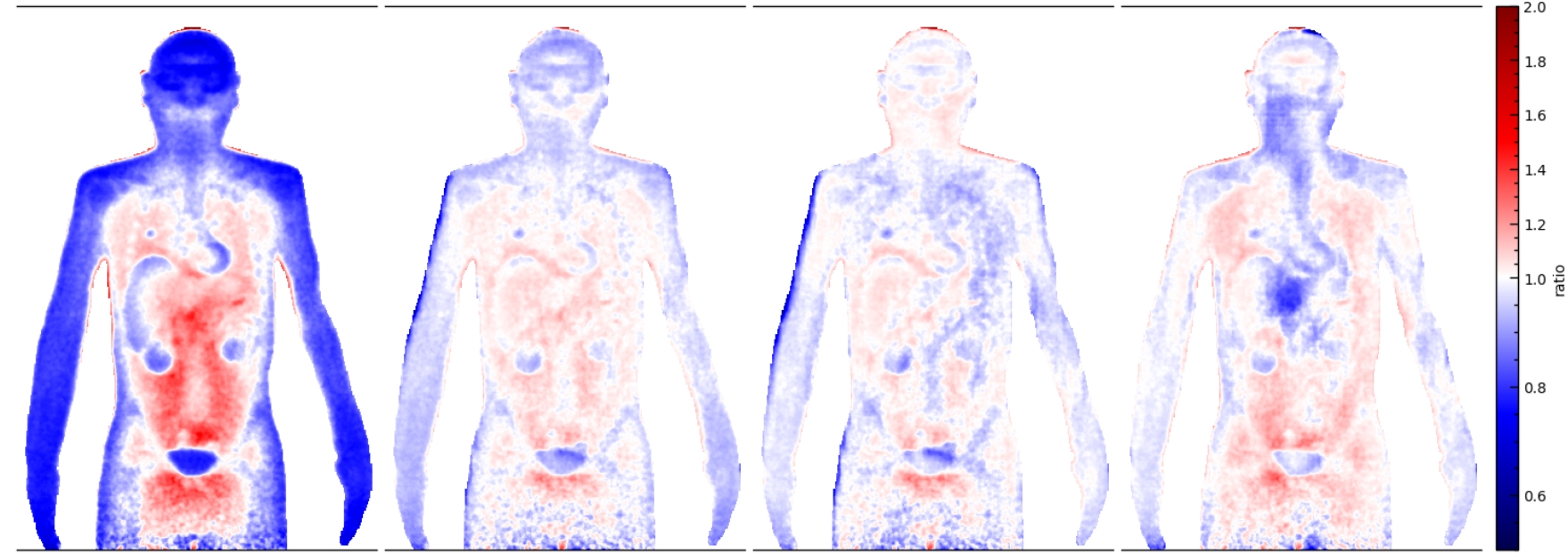
This research introduces a novel method for classifying PET coincidences using 3D spatial encoding and Convolutional Neural Networks (CNNs).
- The Innovation: The team developed a method to encode observed coincidences in 3D space, combining them with information about material density distribution obtained from CT imaging. Such image-based encoding is then processed by a modified ResNet-18 backbone.
- Results: By incorporating spatial information with physical photon parameters (energy and time differences), the model can be trained as a classifier or a “simplex regressor.” Early results show that the softmax classifier variant is the most accurate, producing the highest uniformity and lowest error (MSE) compared to ground-truth images.
2. Multi-Photon Detector Blur Estimation
This work focuses on Positronium (Ps) lifetime imaging (PLI) in modular, total-body PET scanners, specifically those utilising traditional crystal blocks or plastic scintillators for photon detection.
- The Innovation: The researchers proposed a 3D multi-projector System Matrix (SM) modelling approach with PCA compression.
- Impact: This design tackles joint SM modelling for the back-to-back photon pair with the single prompt photon. The improved representation of “resolution effects” (blur) in detector space allows for significant improvement of the novel PLI algorithm. The PCA compression lead to more than a x5 reduction of the pre-computed SM, further reduced by applying the symmetries of detector elements.
This work focuses on Positronium (Ps) Lifetime Imaging (PLI) in modular, total-body PET scanners, specifically those utilising traditional crystal blocks or plastic scintillators for photon detection.
▪ The innovation: The researchers proposed a 3D multi-projector System Matrix (SM) modelling approach with PCA compression.
▪ Impact: This design tackles accurate joint SM modelling for the back-to-back photon pair and the single prompt photon. The improved representation of “resolution effects” (blur) in detector space allows for significant improvement of the novel PLI algorithm. The PCA compression lead to more than a x5 reduction of the pre-computed SM, further reduced by applying the symmetries of detector elements.